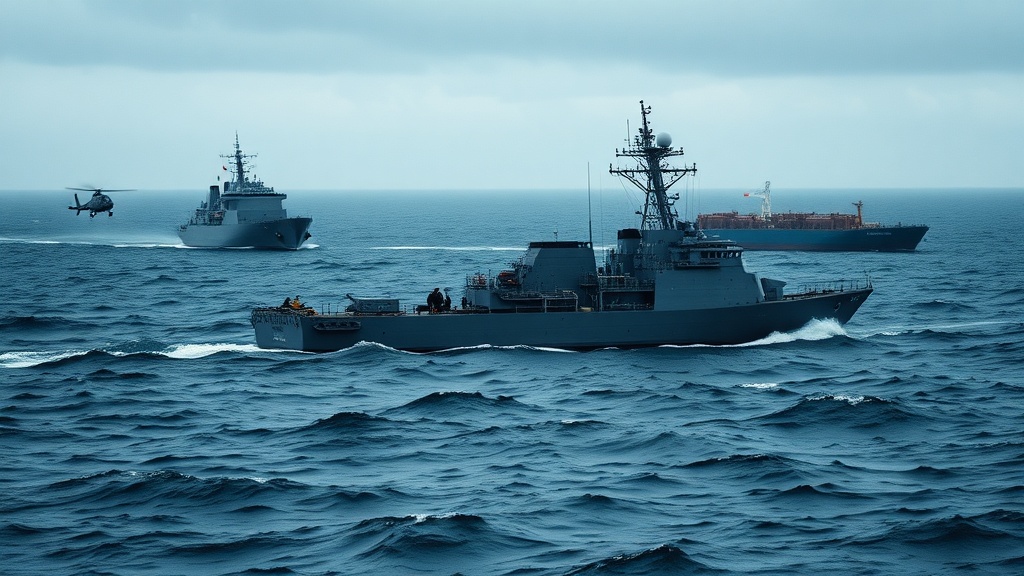
Three Indian sailors killed. The US called it counterterrorism. Their wives called it abandonment.
Left Feed Reality
Progressive and antiwar outlets argue that US military operations in the Strait of Hormuz are producing civilian casualties among third-country nationals who have no stake in the US-Iran confrontation. Three Indian sailors died in US strikes on three vessels this week alone, per Al Jazeera (June 12, 2026). Critics on the left frame this as the inevitable human cost of a military-first policy: working-class South Asian maritime laborers bearing lethal consequences for a geopolitical dispute between Washington and Tehran that they had no vote in and no way to escape.
Sources: Al Jazeera, June 12, 2026
Right Feed Reality
The hawkish case holds that Iranian-linked vessels operating in the Strait of Hormuz have weaponized the maritime corridor for years, and that US military action is a necessary and overdue response to protect global shipping. From this view, the tragic deaths of Indian crew members are ultimately attributable to Iran's strategy of using commercial shipping lanes as cover for weapons transfers and militia resupply, not to US operational decisions. India's repeated summoning of the US Deputy Chief of Mission — twice in rapid succession per The Hindu (June 12, 2026) — is seen as diplomatic pressure that risks undermining the only force currently degrading Iranian naval capacity.
Sources: The Hindu, June 12, 2026
Global POV
The international lens, led by Al Jazeera and Indian outlets, focuses on the specific human cost borne disproportionately by South and Southeast Asian maritime workers — the invisible labor force that keeps global oil moving. NDTV (June 12, 2026) reported that Suresh, an Andhra Pradesh engineer killed in the Oman ship attack, is survived by his wife Bhargavi and sons aged 13 and 10. India has now summoned the US Deputy Chief of Mission at least twice in rapid succession, per The Hindu (June 12, 2026), signaling that New Delhi — a strategic US partner — is running out of diplomatic patience with strikes that keep killing its citizens.
Sources: NDTV, June 12, 2026, The Hindu, June 12, 2026, Al Jazeera, June 12, 2026
What Your Feed Is Hiding
Every perspective in this debate — antiwar left, hawkish right, and even the Indian government — is avoiding the same structural fact: the global maritime industry runs on the labor of low-wage South Asian sailors who have virtually no legal recourse when caught in military operations conducted by states they don't belong to. India can summon envoys and issue protests, but Indian sailors sign contracts under flags of convenience — vessels registered in Panama, Marshall Islands, or Liberia — which strips New Delhi of direct legal jurisdiction over their safety and strips the sailors themselves of any government's full protection. The three Indian sailors killed this week died on vessels flying foreign flags in waters contested by foreign militaries, and their families' only path to compensation runs through private maritime insurers, not any state. Al Jazeera (June 12, 2026) noted the strikes killed three Indian nationals this week, but no reporting has identified which flag states those vessels flew — and that silence is load-bearing.
Key data: Three Indian sailors killed in US strikes on three Hormuz vessels this week (Al Jazeera, June 12, 2026); a vessel with 20 Indian crew was struck in the most recent incident (The Hindu, June 12, 2026); flag-of-convenience registrations mean India has no direct legal jurisdiction over crew safety on foreign-flagged ships.
Where They Actually Agree
Every perspective — hawkish US supporters, antiwar critics, and Indian officials alike — agrees that Indian maritime workers should not be dying in this conflict and that the current situation is diplomatically and humanly untenable. The Hindu (June 12, 2026) reported India's government summoned the US envoy again after yet another strike on a ship with Indian crew, a move that reflects a shared baseline: that civilian nationals of non-belligerent states require protection even during armed operations.
Community Pulse
Should the United States pause military strikes in the Strait of Hormuz when third-country civilian crew are confirmed aboard targeted vessels?
AI-generated analysis based on published sources. TheOtherFeed does not take political positions.