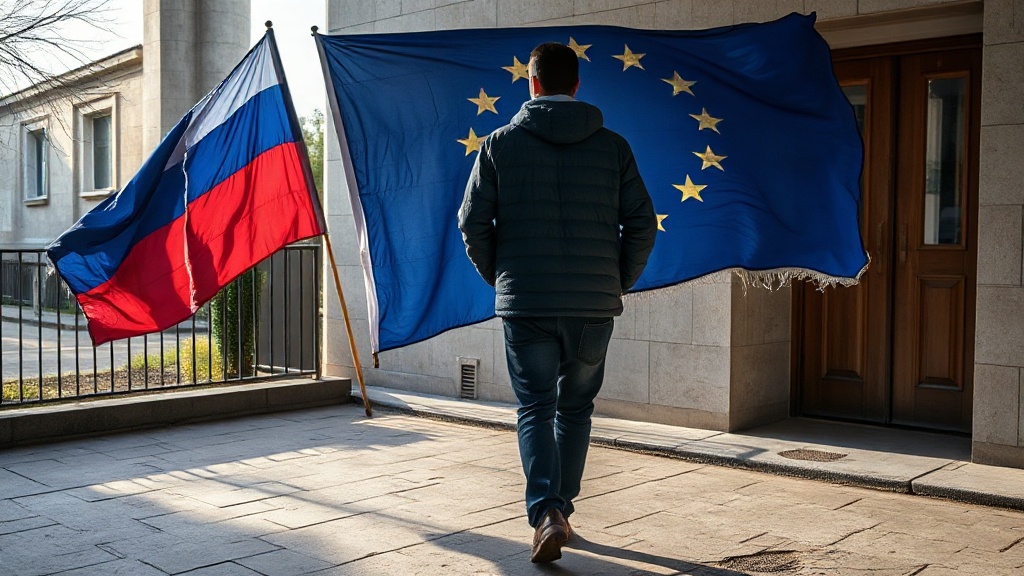
Armenia's election is a referendum Moscow is trying to cancel
Left Feed Reality
Progressive and liberal Western outlets frame this election as a democracy-vs-authoritarianism story. France24 (June 7, 2026) reports Western intelligence officials have confirmed Russia is running covert operations to undermine Pashinyan's re-election bid, explicitly because a Pashinyan victory would 'cement the former Soviet republic's realignment with the West.' The Kremlin's alleged interference — backing billionaire Russian-Armenian businessman Samvel Karapetyan's opposition party — represents exactly the kind of foreign democratic subversion that left-leaning outlets treat as an existential threat to self-determination.
Sources: France24, June 07, 2026, DW News, June 07, 2026
Right Feed Reality
Conservative and realist voices note that Armenia's own government arrested 6 members of the pro-Russia opposition party the day before the election, according to a report linked via Reddit World News (June 7, 2026), citing The Armenian Report. Additionally, Armenian authorities conducted raids on opposition-leaning media outlets in the days before the vote. The right-leaning argument: if Pashinyan's government is suppressing domestic opposition and shutting down media under the cover of a 'Russian threat,' the West's uncritical cheerleading for his 'democratic pivot' looks less like supporting democracy and more like supporting a favored geopolitical outcome.
Sources: Reddit World News / The Armenian Report, June 07, 2026, BBC News, June 07, 2026
Global POV
From a non-Western and regional perspective, this election is inseparable from the unresolved consequences of the 2020 and 2023 Nagorno-Karabakh defeats, which cost Pashinyan enormous domestic credibility. DW News (June 7, 2026) notes he is 'seeking a third term despite falling domestic support.' France24 frames the vote as an 'existential' choice, with one voter citing 'aggressive rhetoric from neighbouring countries' — meaning Azerbaijan and Turkey — as the defining pressure. For much of the Global South, this is not simply a Russia-vs-EU binary but a small landlocked country with a painful history trying to navigate between regional powers without reliable security guarantees from any of them.
Sources: DW News, June 07, 2026, France24, June 07, 2026
What Your Feed Is Hiding
Every narrative in this election — pro-EU liberation, Russian interference, Western democracy promotion — is obscuring a concrete security vacuum that no side has answered. Armenia signed a strategic partnership agreement with the EU in 2017 but remains outside NATO, and the EU has made no formal security commitment to Yerevan. Russia's CSTO alliance formally failed Armenia during the 2023 Azerbaijani offensive that ended Karabakh's existence as an Armenian-populated territory. So the actual choice Armenian voters face is not 'Russian security umbrella vs. Western freedom' — it is 'a broken Russian security umbrella vs. a Western partnership that offers economic integration and zero binding defense obligations.' Both Pashinyan's government and his Russian-backed opponents are campaigning on geopolitical alignment without any candidate having secured a concrete military guarantee from their preferred patron. The arrest of 6 opposition figures the day before the vote also means that whichever side wins will have handed the other a credible democratic-legitimacy grievance to exploit for years.
Key data: The CSTO — Russia's collective security treaty — took no military action to defend Armenia during Azerbaijan's September 2023 offensive that dissolved the Armenian population of Nagorno-Karabakh; the EU's Association Agreement with Armenia (signed 2017) contains no mutual defense clause.
Where They Actually Agree
Every perspective — pro-Pashinyan, pro-Russia, and global — agrees that this election is consequential far beyond normal parliamentary politics and that both external powers are actively attempting to shape its outcome. All sides also implicitly acknowledge that Armenia's security situation is precarious regardless of which geopolitical bloc it leans toward, and that the Karabakh defeat in 2023 fundamentally changed the country's strategic calculations. The disagreement is over which external patron is more dangerous, not over whether external patrons are interfering.
Community Pulse
Is Russia's alleged covert interference in Armenia's election a bigger threat to its democracy than Pashinyan's arrest of opposition members?
AI-generated analysis based on published sources. TheOtherFeed does not take political positions.